Showing posts with label north carolina. Show all posts

Friday, May 31, 2024

2024 North Carolina Southern Flounder Season Closed

Southern Flounder
Southern Flounder | Credit: NOAA Fisheries

To preserve the resource, the North Carolina recreational season for southern flounder will not open in 2024, according to the North Carolina Department of Environmental Quality Marine Fisheries Commission.

In order to preserve the southern flounder resource, the North Carolina recreational flounder season will not open for harvest in 2024.

Estimates from 2023 indicate the recreational catch exceeded the quota allowed under a stock rebuilding plan that was included in Amendment 3 to the Southern Flounder Fishery Management Plan and adopted by the N.C. Marine Fisheries Commission.

The Commission lists the status of southern flounder as overfished and overfishing is occurring. 

Amendment 3 to the Southern Flounder Fishery Management Plan, adopted by the Commission in 2022, set quotas for the recreational and commercial fisheries, based on scientific data, to end overfishing and rebuild the stock. There is a pound-for-pound payback if either sector goes over its quota. 

During it's quarterly business meeting, the Marine Fisheries Commission received an update on the recreational quota available for a recreational founder season.

After subtracting the recreational overage from 2023, the recreational quota remaining for 2024 is not large enough to allow for a season opening. The leftover quota will be used to account for the anticipated dead discards that will occur due to incidental catch and release.

The Commission discussed holding a special meeting to consider alternatives to not holding a 2024 recreational season but ultimately did not move forward with that approach.  

Fisheries managers predict that, following Amendment 3 and not opening the 2024 recreational flounder season, combined with the increased recreational quota in 2025, should allow enough quota for a recreational season next year. 

North Carolina’s southern flounder fisheries are managed under the Southern Flounder Fishery Management Plan Amendment 3.

For more information on the management measures, visit the N.C. Marine Fisheries Commission website (www.deq.nc.gov/about/divisions/marine-fisheries) and see the Southern Flounder Information Page under Hot Topics.

Saturday, March 19, 2022

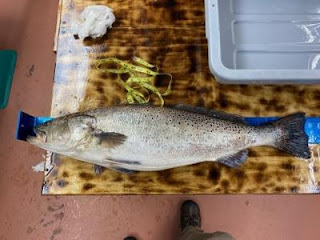
North Carolina State Record Speckled Trout

north carolina state record speckled trout
The North Carolina Division of Marine Fisheries (DMF) recently announced the certification of a new state record speckled trout (Cynoscion nebulosus).

Todd Spangler, of Merritt, caught the 12-pound, 8-ounce fish in the lower Neuse River in Pamlico County on Feb 9, 2022.

The previous state record speckled trout weighed 12 pounds, 4 ounces and was caught off Wrightsville Beach in 1961.

The International Game Fish Association All Tackle World Record spotted seatrout stands at 17 pounds, 7 ounces, and was caught in 1995 off Ft. Pierce Fla.

Spangler’s fish measured 33.5 inches total length (from the tip of the snout to the tip of the compressed tail) and had an 18-inch girth.

He caught it with a Daiwa Procyon reel and custom-built spinning rod. He used a dark purple Z-Man jerk shad soft plastic bait with a 20-pound braid.

Along the Mid Atlantic coast, speckled trout, also known as spotted seatrout, are one of the most popular saltwater species for recreational anglers. Speckled trout are identified by a pattern of dark spots along their backs, flanks, and tail.

For more information on state record fish, go to the division’s State Saltwater Records webpage or contact the North Carolina Saltwater Fishing Tournament staff at saltwater.citations@ncdenr.gov.

source: North Carolina Division of Marine Fisheries

Friday, March 11, 2022

2022 Roanoke River Striped Bass Season

Striped Bass
This spring, the striped bass harvest season in the Roanoke River Management Area will be limited to just four days (April 23-24 and April 28-29.)

Despite the short harvest season, anglers can enjoy catch and release fishing for striped bass on the river.

In February, Cameron Ingram, Executive Director of the North Carolina Wildlife Resources Commission (NCWRC) signed a proclamation outlining significant changes to the 2022 striped bass harvest season in the Roanoke River Management Area.

The entire Roanoke River Management Area will be open for harvest of striped bass April 23 - 24 and April 28 - 29.

In addition, the daily creel limit has changed to one striped bass per day. The minimum length limit is 18 inches, and no striped bass between 22 and 27 inches may be possessed at any time.

The Roanoke River Management Area includes the Roanoke River and tributaries from the Roanoke Rapids Lake Dam downstream to the Albemarle Sound, including the Cashie, Middle, and Eastmost rivers.

In 2020, a stock assessment of striped bass in the Roanoke River/Albemarle Sound indicated that the stock was overfished, and overfishing was occurring. In 2021, the harvest quota in the Roanoke River was reduced from 68,750 pounds to 12,804 pounds as a necessary conservation action intended to rebuild the striped bass population.

Despite season reductions, the striped bass harvest exceeded the 12,804-pound harvest quota in 2021 and payback of the overage is required in 2022 as outlined in the N.C. Estuarine Striped Bass Fishery Management Plan.

The payback means a further reduction of the 2022 quota to 6,578 pounds. The four harvest days outlined in the proclamation were selected using past angler creel data with the goal of anglers having an opportunity to harvest fish throughout the river.

"We have seen dramatic declines in the abundance of striped bass, in particular the number of larger, older females. These larger fish are key in rebuilding the Roanoke River-Albemarle Sound striped bass population," said Ben Ricks, coastal region fishery supervisor with NCWRC.

"Additionally, river flows are very important for spawning success. We work closely with the U.S. Army Corps of Engineers each spring to get the best possible flows for spawning on the Roanoke River and we need to make sure there are plenty of fish on the spawning grounds to take full advantage of those flows."

According to NCWRC, anglers can continue to catch and release striped bass throughout the spring despite the shortened harvest season.

NCWRC recommends that anglers use a single barbless hook or a lure with a single barbless hook to reduce handling stress on fish that are released, which is a requirement from April 1 through June 30 when fishing in the upper Roanoke River above the US Highway 258 bridge near Scotland Neck.

Signage will be posted at boating access areas (BAAs) along the Roanoke River to notify anglers of the changes to the open harvest dates. More information about BAAs on the Roanoke River, including the new Odom BAA in Jackson, can be found using the agency’s online BAA locator.

source: North Carolina Wildlife Resources Commission

Friday, December 20, 2019

2020 North Carolina Ocean Striped Bass Regulations

The striped bass is one of the most important sport fish of North Carolina and the Mid Atlantic Region.
Striped Bass
A slot limit for recreationally-caught striped bass will go into effect January 1, 2020 in North Carolina ocean waters.

Fishermen will be allowed to possess one striped bass per person per day that is at least 28 inches and less than 35 inches total length (fishermen may not keep a 35-inch fish). For the specific regulation, see Proclamation FF-54-2019.

Until the slot limit takes effect on January 1, the minimum size limit for ocean striped bass remains 28 inches total length with a one fish possession limit.

The slot limit is required by the recently adopted Addendum VI to Amendment 6 to the Atlantic Striped Bass Interstate Fishery Management Plan.

The new limit is designed to end overfishing and bring fishing mortality to the target level in 2020 by reducing total coastwide striped bass removals by 18%.

The latest Atlantic States Marine Fisheries Commission (ASMFC) coastwide stock assessment determined that ocean migratory Atlantic striped bass are overfished and overfishing is occurring.

Amendment 6 also requires a coastwide commercial quota reduction of 18%.

For additional information, see the ASMFC news release.

The recreational regulations for striped bass in internal coastal waters of North Carolina remains unchanged.

For more information, visit the Division of Marine Fisheries website.

source: North Carolina Department of Environmental Quality Division of Marine Fisheries

Related Information

Mid Atlantic Saltwater Fishing Facts

Mid Atlantic Striped Bass EEZ Enforcement

Atlantic States Marine Fisheries Commission

Wednesday, November 9, 2016

North Carolina State Record Cubera Snapper

North Carolina state record cubera snapper - 58 pounds (courtesy NC DMF)

A new North Carolina state record cubera snapper has been certified by the state's Division of Marine Fisheries.

Randal Harmon of Morehead City caught the cubera snapper on Sept. 28 while fishing off Atlantic Beach on the Capt. Stacy headboat.

The fish weighed 58 pounds, topping the previous state record by 11 pounds, 8 ounces.

The previous state record was caught in the Atlantic Ocean in 1993. The world record cubera snapper weighed 124 pounds, 12 ounces and was caught off of Louisiana in 2007.

The fish measured 39 inches total length (tip of the nose to the tip of the tail) and had a 34-inch girth.

Harmon caught the record-setting snapper using cut mackerel on 80-pound test line.

Sunday, August 7, 2016

North Carolina State Record Scamp

A recently caught scamp set a North Carolina state record and is a pending IGFA world record.

Teddy Wingfield, a 9-year-old from Lookout Mountain, Tenn., reeled in the enormous scamp on June 2 while fishing in waters off of Atlantic Beach.

The scamp weighed in at 32 pounds, topping the former state record by nearly 5 pounds and the world record by 2 pounds, 6 ounces.

Wingfield has applied for the all-tackle world record title through the International Game Fish Association. The application is pending approval.

The former state record, a 27-pound, 1-ounce fish, was also caught off Atlantic Beach in 2012. The current all-tackle world record scamp is 29 pounds, 10 ounces and was caught off Dauphin Island, Ala. in 2000.

Wingfield’s fish spanned 43 inches total length (tip of the nose to the tip of the tail) and measured 28 inches around the girth.

He caught the scamp while fishing on the Sunrise II charter boat.

source: North Carolina Division of Marine Fisheries

Saturday, June 25, 2016

2015 North Carolina Recreational Saltwater Fishing Statistics

According to recent statistics from the North Carolina Division of Marine Fisheries (NC DMF), recreational saltwater catches increased in 2015. 

Anglers in North Carolina brought an estimated 10.2 million fish to the docks in 2015, an increase of 6.8 percent over 2014. The estimated weight of these landings rose by 32 percent to 11.6 million pounds. Anglers released 6 percent more fish, compared to 2014.

In terms of pounds landed dockside, the top five recreational species for 2015 were dolphin, bluefish, yellowfin tuna, cobia and wahoo.

The number of dolphin taken increased by 132 percent over the previous year to 430,296 fish (3.2 million pounds), the highest since 2011.

Anglers landed 19,284 wahoo weighing 534,787 pounds, a 66 percent increase.

Cobia harvests totaled 15,875 fish weighing 675,859 pounds, the highest since 2013. The average weight of the cobia nearly doubled from 2014.

Anglers brought 10.7 percent fewer yellowfin tuna to the docks; 24,205 fish weighing approximately 723,127 pounds.

NC DMF speculates that dolphin, wahoo and cobia harvests may have increased as a result of an absence of yellowfin tuna.

Recreational harvests of bluefish decreased by 16 percent to 911,983 fish (769,262 pounds).

Spotted seatrout harvests for 2015 were estimated to be the lowest on record. The low catches follow back to back cold stuns in 2013 and 2014.

NC DMF closed spotted seatrout harvest Feb. 5 to June 15 in 2014 to allow the fish that survive the cold stun event the maximum chance to spawn in the spring.

Another possible factor may have been the abnormal amount of rainfall in eastern North Carolina in the fall and winter of 2015 that flushed the creeks with freshwater, causing fish to move to higher salinities.

Despite low spotted seatrout harvests in 2015, estimates of recreational released catch (undersized) were at near record levels.

For a full landings report, visit http://portal.ncdenr.org/web/mf/marine-fisheries-catch-statistics.

source: North Carolina Division of Marine Fisheries

Thursday, May 19, 2016

North Carolina Artificial Fishing Reef Site 330

On May 7, 2016 the NC Division of Marine Fisheries sank two vessels in the Artificial Fishing Reef Site 330, a permitted site located approximately
9.8 NM west-southwest of the Beaufort Inlet Channel Sea Buoy (LLNR 730).

Artificial Fishing Reef Site 330 is referenced on chart 11543 as
“Obstn Fish Haven” located at position Latitude 34° 33’22” N, Longitude 076° 51’16” W. The two vessels were sunk in 60 ft of water with 11 ft of
water over the vessel structures.

Vessel Locations (approximate):

WILLIAM SEA sunk between 34° 33’49” N / 76° 51’21” W and 34° 33’48”
N / 76° 51’21”

TRAMP was sunk between positions 34° 33’49” N / 76° 51’21” W and 34° 33’49” N / 76° 51’23” W.


For more information, contact the North Carolina Division of Marine Fisheries, Artificial Reef Coordinator at 252-726-7021.

source: U.S. Coast Guard 5th District LNM

Tuesday, April 5, 2016

North Carolina State Record False Albacore

The North Carolina Division of Marine Fisheries recently certified a new state record for false albacore.

Michael Voytkowski of Waverly, Penn., landed the fish in April, 2015, but only recently applied for the state record honor.

He caught the false albacore while fishing on the charter boat Beagle at the Big Rock off Morehead City.

The fish weighed 32 pounds and measured 39.75 inches curved fork length (CFL) with a girth of 24.25 inches.

The former state record for false albacore was 25 pounds, 8 ounces. The world record for false albacore is 36 pounds. That fish was caught off New Jersey in 2006.

source: North Carolina Division of Marine Fisheries

Wednesday, January 27, 2016

North Carolina State Record White Marlin

The North Carolina Division of Marine Fisheries has certified a new state record for white marlin.

Neil Manning of Ashburn, Va. reeled in the fish on November 16 while fishing off Hatteras. The fish was caught using live menhaden on 30-pound test line.

The marlin weighed 138 pounds, had a girth of 37 inches, and measured 85 inches from the tip of the lower jaw to the fork in the tail.

The world record for white marlin is 181 pounds, 14 ounces, caught off the coast of Brazil.

source: North Carolina Division of Marine Fisheries

Sunday, November 29, 2015

2016 North Carolina Southern Flounder Regulations

The N.C. Marine Fisheries Commission recently announced it has adopted a supplement to the Southern Flounder Fishery Management Plan.

New regulations will include a combination of size limit changes, modifications to fishing gear allowances, total allowable landings, and season closures.

Beginning Jan. 1, 2016, the commercial minimum size limit will go up from 14 inches to 15 inches, making it the same as the recreational fishery.

A 6-inch minimum mesh size will be in effect for anchored large-mesh gill nets. Starting in 2016, a statewide season closure of anchored, large-mesh gill nets will be put in place each year from Oct. 16-Dec. 31.

Also beginning in 2016, the recreational southern flounder season will close Oct. 16-Dec. 31 for the hook-and line and gig fisheries.

Flounder pound nets will be subject to a 5 ¾-inch escape panel requirement. Flounder pound nets will also be subject to total allowable landings for different water bodies that represent a 38 percent reduction compared to 2011-2015 pound net landings.

The commercial gig fishery will close when the pound net quota is met.

The Dec. 1-31 commercial southern flounder closure will remain in effect this year.

The N.C. Division of Marine Fishery plans to present information on what the quotas will be under these regulations at the commission’s February, 2016 meeting.

source: North Carolina Marine Fisheries Commission

Monday, July 13, 2015

2015 North Carolina Coastal Fish Stock Status Report

Five North Carolina coastal fish species have been reclassified as viable by the 2015 Stock Status Report by the N.C. Division of Marine Fisheries.

The report also reclassified the status of three other species and removed one species from the report. Reclassifications are based on updated information through 2014.

The division annually classifies the status of important marine finfish, shellfish, shrimp and crabs as viable, recovering, concern, depleted or unknown. The classifications serve as a barometer of the overall health of the state’s fishery resources, and they are used to prioritize development of state fishery management plans.

Atlantic menhaden moved from concern to viable based on a Southeast Data, Assessment and Review 2015 benchmark stock assessment that indicates that Atlantic menhaden are neither overfished nor experiencing overfishing.

Black drum moved from unknown to viable based on a 2015 Atlantic States Marine Fisheries Commission Black Drum Stock Assessment that determined that the stock is not overfished and not experiencing overfishing.

Kingfishes moved from unknown to viable based on positive trends in biological data, as a regional stock assessment is not currently available.

King mackerel moved from concern to viable based on the 2014 South Atlantic Fishery Management Council stock assessment that indicates the South Atlantic king mackerel stock is not overfished and overfishing is not occurring.

Spotted seatrout moved from depleted to viable based on a 2014 N.C. Spotted Seatrout Stock Assessment that indicates the North Carolina and Virginia stock is not overfished and overfishing is not occurring.

Black sea bass north of Hatteras moved from recovering to concern due to the lack of a recent approved stock assessment and recent low landings in North Carolina waters. The stock was declared rebuilt in 2009 based on the 2008 National Marine Fisheries Service’s Northeast Fisheries Science Center stock assessment for U.S. waters north of Cape Hatteras. Due to unique life history characteristics and other data concerns, the 2011 and 2012 assessments were not accepted for determining stock status.

Southern flounder was moved from depleted to concern due to the lack of a recent approved stock assessment. A 2014 stock assessment of southern flounder in North Carolina waters could not be used to determine stock status because the southern flounder stock mixes throughout the South Atlantic (North Carolina to Florida). However, concerns exist about the sustainability of current harvest levels because of a coast-wide decline in juvenile and adult abundance.

Gag moved from concern to recovering based on a 2014 South Atlantic Fishery Management Council regional stock assessment that found the stock from North Carolina to Florida was experiencing overfishing, but was not overfished. The National Marine Fisheries Service removed the stock from the overfishing list in December 2014 after determining that harvest levels in 2012 and 2013 indicated overfishing was no longer occurring.

Monkfish was removed from the N.C. Stock Status Report due to the limited fishery in North Carolina. In 2014, commercial landings of monkfish were low and there were no reported recreational landings.

Definitions for each stock status category can be found at http://portal.ncdenr.org/web/mf/stock-status-categories-and-definitions.

The complete 2015 Stock Status Report can be found on the division’s website at: http://portal.ncdenr.org/web/mf/stock-status-reports.

source: North Carolina Division of Marine Fisheries

Monday, May 25, 2015

2014 North Carolina Recreational Fishing Landings

Recreational fishermen in North Carolina harvested approximately 9.6 million fish, weighing about 9 million pounds in 2014, according to the division’s Coastal Angling Program. The 2014 total was 29 percent lower than the average of recreational landings from 2010 to 2013.

North Carolina Recreational Harvests

The top 5 recreationally harvested fish (in pounds) in 2014 were dolphin, bluefish, yellowfin tuna, spot, and red drum.

Recreational dolphin landings decreased by 14 percent to 1.3 million pounds

bluefish landings decreased by 3 percent to 961,222 pounds

yellowfin tuna landings decreased by 37 percent to 913,785 pounds.

Red drum harvests decreased by 12 percent to 598,166 pounds, after the highest landings on record in 2013.

Spot harvests increased by 53 percent in 2014 to 704,445 pounds.


North Carolina Recreational Fishing Trips
The number of private boat fishing trips dropped by 18.7 percent.

The number of for-hire fishing trips dropped by 8 percent.

the number of beach and bank fishing trips increased by 37.3 percent.

For a full landings report, click on the 2014 Annual Fisheries Bulletin link at http://portal.ncdenr.org/web/mf/marine-fisheries-catch-statistics.

For more information, contact division License and Statistics Section Chief Don Hesselman at 252-808-8099 or Don.Hesselman@ncdenr.gov.

Friday, April 24, 2015

New North Carolina Fishing License Changes (Recreational - Captain's)

The North Carolina Department of Environment and Natural Resources recently announced new rules impacting for-hire fishing operations and ocean fishing piers.

New Rule Highlights:

 - Elimination of current For-Hire Permit and Coastal Recreational Fishing License blanket licenses, replacing with a captain’s for-hire license, a blanket for-hire vessel license, and a non-blanket for-hire vessel license, to be consistent with current state law.

 - Combining two separate ocean pier licenses into one Ocean Fishing Pier License with the same net cost. 

The rules will be included in 2015 North Carolina Marine Fisheries Commission Rules (2015 rulebook) and will be posted online at http://portal.ncdenr.org/web/mf/rules-and-regulations by May 1.

source: North Carolina Department of Environment and Natural Resources

North Carolina - Francesconi Reef (Proposed)

In North Carolina, a group of divers and fishermen want to honor former Artificial Reef Coordinator Jim Francesconi by sinking a ship in his name. They have started a fundraising campaign to help pay for the purchase of a vessel and the towing, cleaning and sinking process.

The group wants to purchase a 180- to 200-foot vessel, rename it after Francesconi, and sink it on the Howard Chapin Reef (AR-330), about 12 miles outside of Beaufort Inlet.

The N.C. Division of Marine Fisheries has agreed to the plan and hopes to schedule the project for mid-July in commemoration of Francesconi’s passing.

Francesconi, who began working for the division in 1987, headed the Artificial Reef Program for 14 years before losing a battle with leukemia on July 18, 2014.

His efforts resulted in hundreds of enhancements to artificial reefs from the Outer Banks to Long Bay, including the creation of the New River Reef (AR-398) near Jacksonville, the Jim Knight Reef (AR-430) near Oak Island and the Bob Black Reef (AR-400) near Frying Pan Tower.

He also oversaw the sinking of the U.S. Coast Guard cutter SPAR, the Tug Titan, the Captain Greg Mickey, the Tug Pawtucket, the Admiral Charlie, and two U.S. Coast Guard Falcon aircraft.

The fundraising group is headed by Bobby Purifoy of Olympus Dive Center in Morehead City, Debby Boyce of Discovery Diving in Beaufort and Carteret County diver Steve Broadhurst. They have set up accounts for donations with the East Carolina Artificial Reef Association and the Big Rock Blue Marlin Tournament.

About $70,000 of the cost will come from a special fund that receives money from the sale of SCUBA license plates, created in 2005 through the N.C. Division of Motor Vehicles license plate program to develop North Carolina’s artificial reefs. The division estimates another $50,000 is needed to make the project a reality.

Donations may be made through the East Carolina Artificial Reef Association at 252-728-2265 and the Big Rock Blue Marlin Tournament at 252-247-3575. Donations may be made electronically to the Big Rock Blue Marlin Tournament account through http://www.gofundme.com/jjf-reef-project.

source: North Carolina Department of Environment and Natural Resources

Thursday, March 5, 2015

North Carolina Southern Flounder Fishery Management Plan

The North Carolina Marine Fisheries Commission moved toward temporary management measures for southern flounder at its February meeting. The commission also voted to pursue a supplement to the N.C. Southern Flounder Fishery Management Plan to reduce the catch of southern flounder by between 25 percent and 60 percent. The division will present options to the commission on ways to do this at its May meeting.

The action followed a report on a draft 2014 N.C. Southern Flounder Stock Assessment. The division did not accept the stock assessment for management purposes after three peer reviewers noted the same concerns the division has.

Some of the concerns are about recent studies showing that the North Carolina stock of southern flounder mixes with stocks in other South Atlantic states. These concerns can only be addressed with a regional stock assessment that includes data from other states.

The draft stock assessment indicates that recruitment (the number of young fish entering into the stock) has declined since the 1990s.

source: North Carolina Marine Fisheries Commission

North Carolina For Hire Logbook Requirement Delayed

At its February meeting, the North Carolina Marine Fisheries Commission voted to delay voting on a proposed rule regarding a for-hire logbook requirement until the August meeting in order to get more stakeholder input before the decision.

The delay came after a large group of people from the for-hire industry at the meeting expressed concerns about the for-hire logbook requirement.

The proposed rule would implement a recent change in state law and require charter and guide captains to submit a logbook detailing their for-hire fishing activity for the previous week.

If implemented, for-hire logbook information would go to the N.C. Division of Marine Fisheries (DMF) for management purposes.

source: North Carolina Marine Fisheries Commission

Wednesday, December 10, 2014

North Carolina Striped Bass Regulations - Atlantic Ocean and Albemarle Sound-Roanoke River Management Areas

New harvest limits for striped bass in the Atlantic Ocean and in the Albemarle Sound/Roanoke River areas will take effect for the upcoming winter seasons.

Atlantic Ocean

The recreational daily bag limit for ocean striped bass will drop from two fish per day to one fish per day on Jan. 1.

The minimum size limit for striped bass in the Atlantic Ocean will remain at 28 inches for both the commercial and recreational fishery.

Albemarle Sound and Roanoke River Management Areas

The annual recreational harvest limits for the Albemarle Sound and Roanoke River Management Areas are:

68,750 pounds for the Albemarle Sound Management Area recreational fishery.

68,750 pounds for the Roanoke River Management Area recreational fishery.

The recreational size and bag limits remain the same.

The above management changes are necessary for the state to comply with the recent approval of Addendum IV to Amendment 6 to the Atlantic States Marine Fisheries Commission’s Interstate Fishery Management Plan for Atlantic Striped Bass.

The addendum responds to results of the 2013 Atlantic striped bass benchmark assessment and the 2013 Albemarle/Roanoke striped bass benchmark assessment. Both assessments show similar trends for the coastwide stock and the Albemarle/Roanoke stock, indicating fishing mortality in 2012 was above the target, and female spawning stock biomass has been steadily declining below the target level since the mid-2000s.

source: North Carolina Department of Environment and Natural Resources

Monday, December 1, 2014

North Carolina Fish License Plates

The North Carolina Division of Marine Fisheries is taking applications for new North Carolina red drum license plates. The new plates will feature an illustration of a red drum against a background of sea grass.

The top of the plate reads, "RED DRUM" and the bottom reads "NORTH CAROLINA." Red Drum was officially adopted as North Carolina’s state saltwater fish in 1971.

The red drum tag is the twin of a new native brook trout license plate that features the state’s freshwater fish. The two license plates were the brainchild of Jon Jicha, a professor in Western Carolina University’s School of Art and Design.

The N.C. Division of Motor Vehicles will not issue the red drum license plate until 500 applications are received. Revenue from the sale of red drum plates is earmarked to fund public access to and habitat protection of red drum waters.

source: North Carolina Division of Marine Fisheries

Friday, July 4, 2014

Albemarle-Roanoke Striped Bass Stock Classified to Concern Status

The N.C. Division of Marine Fisheries’ 2014 Stock Status Report reclassifies the Albemarle/Roanoke striped bass stock from “viable” to “concern,” due to biological factors associated with a declining population.

The division annually grades the status of important marine finfish, shellfish, shrimp and crabs as viable, recovering, concern, depleted or unknown. The grades serve as a barometer of the overall health of the state’s fishery resources, and they are used to prioritize development of fishery management plans.

While a 2010 stock assessment concludes the stock is not overfished, several population trends have prompted concern about the status of striped bass fishery. Since 2002, the number of young fish entering the population has declined, causing a steady decrease in landings from the peak harvest in 2004. A new Albemarle/Roanoke striped bass stock assessment is scheduled to be approved in August, and reductions in harvest limits likely will be necessary.

Striped bass in North Carolina are managed by the N.C. Marine Fisheries Commission and the N.C. Wildlife Resources Commission, and data collected by both agencies are used to assess the status of the stocks. Amendment 1 to the N.C. Estuarine Striped Bass Fishery Management Plan was approved by both commissions in 2013.      

Stocks exhibiting declining landings may be classified as “concern” even if they have an approved stock assessment and fishery management plan, as is the case with the Albemarle/Roanoke striped bass stock.

The stock status of all other species remained the same as the 2013 report.

The complete 2014 Stock Status Report can be found at the Division of Marine Fisheries’ website at: http://portal.ncdenr.org/web/mf/stock-status-reports.

For more information on the 2014 Stock Status Report, contact Lee Paramore at 252-473-5734, ext. 222 or Lee.Paramore@ncdenr.gov.

source: N.C. Department of Environment and Natural Resources