Showing posts with label spotted seatrout. Show all posts

Saturday, November 9, 2024

2022 Saltwater Fishing Statistics - NOAA FUS Report

scup
Scup

In November, NOAA Fisheries released its 2022 Fisheries of the United States (FUS) report.

2022 U.S. Recreational Fishing Highlights

According to the report, U.S. anglers took more than 200 million trips in 2022, catching an estimated 1.1 billion fish and releasing 61 percent of those caught.

In 2022, U.S. anglers harvested approximately 437 million fish with a combined weight of 356.2 million pounds.

By weight, striped bass was the top species harvested, with anglers harvesting 35.9 million pounds (3.5 million fish) in 2022.

By number of fish, scup was the top species harvested, with anglers harvesting 17.7 million fish in 2022.

Spotted seatrout was the top species in terms of total catch (harvested and released fish), with anglers catching 55 million fish.

Fisheries of the United States provides a snapshot of data, primarily at the national level, on U.S. commercial fisheries landings and value and recreational catch.

Produced in various forms for more than 100 years, Fisheries of the United States is the NOAA Fisheries yearbook of fishery statistics for the United States.

Together with Status of the Stocks and Fisheries Economics of the United States, the report provides information related to saltwater fishing and seafood. 

In April, NOAA fisheries released Fisheries Economics of the United States, 2002.

Related Information

2020 Saltwater Fishing Statistics - NOAA FUS Report

Saturday, March 19, 2022

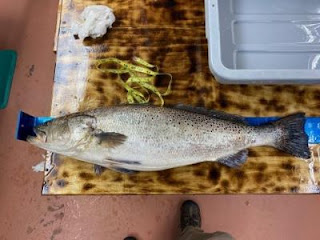
North Carolina State Record Speckled Trout

north carolina state record speckled trout
The North Carolina Division of Marine Fisheries (DMF) recently announced the certification of a new state record speckled trout (Cynoscion nebulosus).

Todd Spangler, of Merritt, caught the 12-pound, 8-ounce fish in the lower Neuse River in Pamlico County on Feb 9, 2022.

The previous state record speckled trout weighed 12 pounds, 4 ounces and was caught off Wrightsville Beach in 1961.

The International Game Fish Association All Tackle World Record spotted seatrout stands at 17 pounds, 7 ounces, and was caught in 1995 off Ft. Pierce Fla.

Spangler’s fish measured 33.5 inches total length (from the tip of the snout to the tip of the compressed tail) and had an 18-inch girth.

He caught it with a Daiwa Procyon reel and custom-built spinning rod. He used a dark purple Z-Man jerk shad soft plastic bait with a 20-pound braid.

Along the Mid Atlantic coast, speckled trout, also known as spotted seatrout, are one of the most popular saltwater species for recreational anglers. Speckled trout are identified by a pattern of dark spots along their backs, flanks, and tail.

For more information on state record fish, go to the division’s State Saltwater Records webpage or contact the North Carolina Saltwater Fishing Tournament staff at saltwater.citations@ncdenr.gov.

source: North Carolina Division of Marine Fisheries

Saturday, June 25, 2016

2015 North Carolina Recreational Saltwater Fishing Statistics

According to recent statistics from the North Carolina Division of Marine Fisheries (NC DMF), recreational saltwater catches increased in 2015. 

Anglers in North Carolina brought an estimated 10.2 million fish to the docks in 2015, an increase of 6.8 percent over 2014. The estimated weight of these landings rose by 32 percent to 11.6 million pounds. Anglers released 6 percent more fish, compared to 2014.

In terms of pounds landed dockside, the top five recreational species for 2015 were dolphin, bluefish, yellowfin tuna, cobia and wahoo.

The number of dolphin taken increased by 132 percent over the previous year to 430,296 fish (3.2 million pounds), the highest since 2011.

Anglers landed 19,284 wahoo weighing 534,787 pounds, a 66 percent increase.

Cobia harvests totaled 15,875 fish weighing 675,859 pounds, the highest since 2013. The average weight of the cobia nearly doubled from 2014.

Anglers brought 10.7 percent fewer yellowfin tuna to the docks; 24,205 fish weighing approximately 723,127 pounds.

NC DMF speculates that dolphin, wahoo and cobia harvests may have increased as a result of an absence of yellowfin tuna.

Recreational harvests of bluefish decreased by 16 percent to 911,983 fish (769,262 pounds).

Spotted seatrout harvests for 2015 were estimated to be the lowest on record. The low catches follow back to back cold stuns in 2013 and 2014.

NC DMF closed spotted seatrout harvest Feb. 5 to June 15 in 2014 to allow the fish that survive the cold stun event the maximum chance to spawn in the spring.

Another possible factor may have been the abnormal amount of rainfall in eastern North Carolina in the fall and winter of 2015 that flushed the creeks with freshwater, causing fish to move to higher salinities.

Despite low spotted seatrout harvests in 2015, estimates of recreational released catch (undersized) were at near record levels.

For a full landings report, visit http://portal.ncdenr.org/web/mf/marine-fisheries-catch-statistics.

source: North Carolina Division of Marine Fisheries

Wednesday, November 5, 2014

2013 Top Recreational Fishing Saltwater Species

U.S. recreational anglers took 71 million trips and caught nearly 430 million fish in 2013. Over 61 percent of these fish were released alive. Spotted seatrout was the top catch for recreational anglers in 2013, with 38 million fish caught.

Top 5 Recreational Fishing Saltwater Species (2013):

1. spotted seatrout
2. Atlantic croaker
3. black sea bass
4. summer flounder
5. red drum

source: Fisheries of the United States, 2013 (NOAA Fisheries)

Tuesday, February 11, 2014

North Carolina Spotted Seatrout Winter Fish Kills

Recent "cold stun" events in North Carolina could affect spotted seatrout populations as well as other species of saltwater fish.

N.C. Division of Marine Fisheries biologists discovered numerous cold stun events on Friday, January 31 and Saturday, February 1.

Cold stun events were confirmed in the Pamlico, Alligator, Pungo, Scuppernong, Trent, Neuse and Cape Fear rivers; Chocowinity, Blounts and Chadwick bays; and Slades, Bath, Cahooque, Hancock and Spooners creeks.

source: North Carolina Division of Marine Fisheries

Thursday, January 13, 2011

North Carolina Spotted Seatrout Harvest Moratorium Due to Cold Stun Events

North Carolina will close all coastal waters to commercial and recreational spotted seatrout harvest for an indefinite period beginning at noon Friday, January 14, 2011.

N.C. Division of Marine Fisheries Director Louis Daniel issued a proclamation on January 12 implementing the closure, after consulting with N.C. Marine Fisheries Commission Chairman Rob Bizzell.

The action is being taken in response to recent cold stun events in Rose Bay, Juniper Bay, Pungo River, Campbell Creek, Turnigan Bay, Spooners Creek and other waters. The intent of the closure is to prevent the harvest of vulnerable cold stunned fish, which may recover with warming temperatures.

"On the heels of two cold stun events, one in 2010 and now in 2011, and pretty large commercial and recreational catch rates in 2009, I believe this is the best thing for the fishery," Daniel said.

In approving the Spotted Seatrout Fishery Management Plan in November, the Marine Fisheries Commission authorized Daniel to temporarily close harvest in the event of a cold stun event. The commission will review the closure and consider extending it at is Feb. 11 meeting in Pine Knoll Shores.

For more information, contact division biologist Beth Burns at (252) 473-5734, extension 221, or Beth.Burns@ncdenr.gov

source: N.C. Division of Marine Fisheries

Thursday, July 1, 2010

2010 North Carolina Report Shows Continued Recovery and Viability of Saltwater Fish

The N.C. Division of Marine Fisheries’ 2010 Stock Status report shows saltwater fish populations in North Carolina are stable and, in many cases, improving.

Spiny dogfish moved from “recovering” to “viable” based on a 2010 stock assessment that found that the stock has been rebuilt.

Summer flounder remains listed as recovering and striped bass in the ocean and in the Albemarle Sound-Roanoke River Management Area remain listed as viable.

Additionally, bay scallops continue to recover, allowing for periodic season openings in some water bodies. Oysters, while remaining listed as “concern,” have shown signs of improvement with increased landings and increased spat fall in both wild harvest areas and in sanctuaries.

Spotted seatrout, however moved from “concern” to “depleted” based on a 2009 stock assessment. The assessment indicated the stock is overfished and undergoing overfishing based on data from 1991-2008.

The annual stock status report serves as a general barometer of the overall health of North Carolina’s coastal fishery resources, and it is used to prioritize development of fishery management plans and subsequent plan amendments. 

The 2010 Stock Status Report can be found online at http://www.ncfisheries.net/stocks/index.html